You can size a solar power system yourself. The math is short, and it follows a fixed order. Battery storage now comes with 37% of U.S. home solar installations, so getting these numbers right matters more than ever.
Start with your daily energy use. The average U.S. household draws roughly 30 kWh per day. Next, apply depth of discharge, then temperature derating. Convert units so amp-hours and kilowatt-hours line up. Finally, decide your days of autonomy for backup power.
A worked example and a quick-reference table later in this guide let you estimate your own solar power storage needs fast, without guesswork.
Key Takeaways
-
Calculate your daily energy use first. This number sets the size for your whole solar system.
-
Size your battery using depth of discharge and temperature. Cold weather and battery type change the usable capacity.
-
Convert amp-hours to kilowatt-hours before you compare batteries. Voltage matters for energy storage.
-
Choose your days of autonomy for backup power. Two days is a common target for most homes.
-
Check your peak load separately from daily energy. A small inverter can waste a full battery bank.
Key Factors to Size a Solar Power System
Sizing is a package deal. You determine inverter, battery, and panel sizes together, not in isolation. A solar array with battery storage only performs well when all three parts match your load profile. Start with the two factors below, and the rest of the numbers fall into place.
Daily Energy Consumption
Your utility bill is the fastest starting point. The summary shows total kilowatt-hours (kWh) for the billing period, and most bills graph monthly usage over the past 12 months. Divide the annual total by 365 to get your average daily kWh. A 4,000 sq ft house, for example, uses roughly 1,640 kWh per month. That works out to a daily average electricity usage near 54 kWh.
Bills smooth over habits, so build an appliance list for accuracy. Multiply each appliance's wattage by its daily run-time, then divide by 1,000 to convert to kWh. A 100 W bulb run 6 hours uses (100 × 6) ÷ 1,000 = 0.6 kWh per day. A 1,500 W space heater run 3 hours draws 4.5 kWh. Add every appliance to get your daily electricity usage. Heating and cooling dominate most homes at 54% of total use, so treat HVAC numbers with care.
For the solar array component, you can also explore GREENSUN's N-Type Solar Panels when comparing panel options for your system.
| Appliance | Typical Wattage (W) |
|---|---|
| Refrigerator | 100–800 |
| Air conditioner | 500–3,500 |
| Clothes dryer | 1,800–5,000 |
| Dishwasher | 1,200–2,400 |
| Television | 50–400 |
Critical Loads and Backup Needs
An outage changes the question. Critical loads are the devices that must keep running: refrigeration, lighting, communications, well or sump pumps, and medical equipment such as CPAP machines. These loads set a floor for battery size for your home. You cannot size below them, whatever the budget says.
Add the essentials up. A refrigerator cycling at 150 W for 8 hours uses 1,200 Wh. Five LED lights at 50 W total for 6 hours add 300 Wh. A modem and router at 15 W around the clock add 360 Wh, and phone charging adds 40 Wh. The estimated daily total is 1,900 Wh, or 1.9 kWh.
Required Battery Capacity = (Daily Energy Wh × Desired Backup Days) / Battery Efficiency.
That 1.9 kWh figure is the target your solar battery you need must meet for each backup day you choose. High-efficiency chemistries such as LiFePO4 carry a high depth of discharge, so the bank delivers close to its rated storage capacity. This critical-load total also anchors the number of solar batteries in your design. Compare it against whole-home consumption before you commit. A solar system with battery sized to critical loads costs less and still covers real emergencies. Storage solar systems built this way serve both everyday savings and outage protection, and solar energy systems designed around measured loads rarely disappoint.
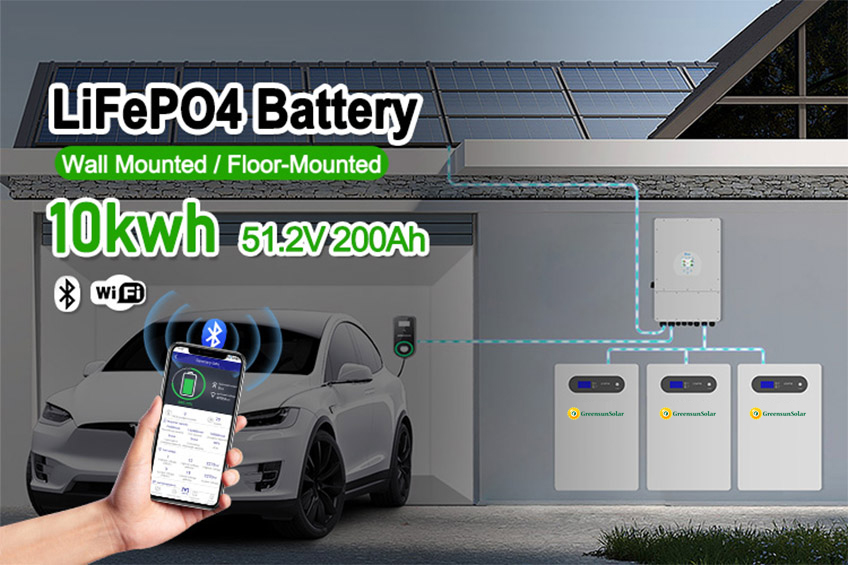
Solar Battery Sizing: Depth of Discharge and Temperature
Usable Capacity and Depth of Discharge
Battery sizing starts with one formula. Battery capacity in kWh = (daily energy consumption ÷ efficiency) ÷ depth of discharge. Daily consumption comes from your bill or appliance list. Efficiency covers round-trip losses, which for lithium-ion often exceed 90%. Depth of discharge (DoD) is the share of rated capacity you actually draw before recharging.
Run the numbers. A home using 10 kWh per day with 80% usable DoD needs 10 ÷ 0.8 = 12.5 kWh of rated solar battery capacity. That gap between 10 and 12.5 kWh is the reserve the bank must hold but never spend. Chemistry changes the math. Lead-acid typically caps at 50% DoD, so the same load demands a much larger bank. LiFePO4 tolerates 80–90% DoD, which shrinks the number of solar batteries you must buy.
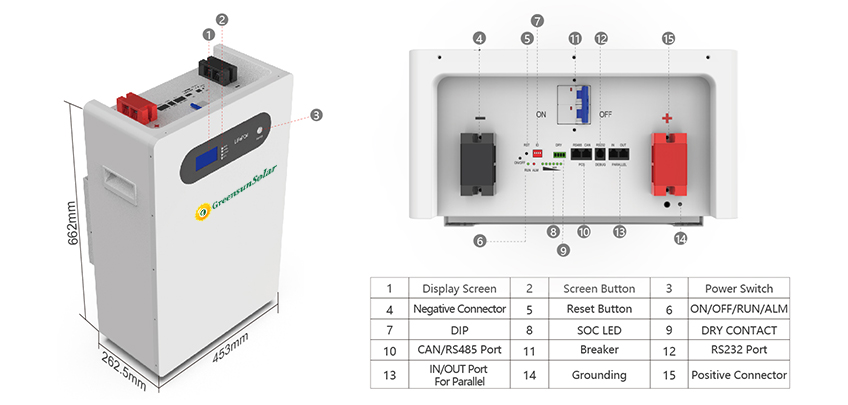
When comparing LiFePO4 options, GREENSUN also offers 10.24kWh Home Energy Storage LiFePO4 Battery, which provides a practical reference for evaluating rated and usable battery capacity.
| Battery Type | Max Recommended DoD | Usable Ah from 100Ah |
|---|---|---|
| Flooded lead-acid | 50% | 50Ah |
| AGM | 50% | 50Ah |
| Gel | 50% | 50Ah |
| LiFePO4 | 80–90% | 80–90Ah |
Cycle life rewards shallow cycling. LiFePO4 reaches roughly 4,000–6,000+ cycles at 80–90% DoD. An 80% DoD is the usual compromise for daily use.
Temperature Derating and Losses
Temperature moves usable energy capacity in both directions. Cold raises internal resistance and cuts discharge capacity; a lead-acid battery may deliver only about half its nominal capacity at 0°F. Lithium-ion charges from 32°F to 113°F and discharges from –4°F to 140°F, and its BMS blocks charging below roughly 0°C to prevent lithium plating.
Heat is the quieter threat. Batteries perform best when stored between 15–30 °C, and efficiency decreases in very cold and very hot temperatures. For lead-acid, lifetime typically halves for every 8–10°C above 25°C.
Add a safety margin for cold climates. Size the bank above your calculated figure so winter losses do not strand critical loads. As a rule of thumb, total battery capacity near half of daily electricity usage can be cost-effective, and sizing to 50%–80% of daily excess solar production keeps storage capacity matched to real charging.
Find Your Solar Power Storage Battery Capacity in Practical Units
Convert Solar Battery Capacity Units
Battery labels mix units, so convert before you compare products. Amp-hours describe charge, not energy. You need voltage to reach watt-hours, and the relationship is simple.
Wh = Ah × V, and kWh = Wh ÷ 1000. Inverse: Ah = Wh ÷ V.
A 200 Ah battery at 12 V stores 200 × 12 = 2,400 Wh, or 2.4 kWh. The same 200 Ah at 51.2 V stores 10,240 Wh, or 10.24 kWh. Common bank voltages are 12 V, 24 V, 48 V, and 51.2 V for LiFePO4 packs. A 51.2 V nominal pack usually serves the "48V" system class, so verify the datasheet rather than the label.
You can compare different battery configurations through GREENSUN's LV and HV Energy Storage Battery range, including different voltage and capacity options.
| Amp-hours | Voltage | Watt-hours | Kilowatt-hours |
|---|---|---|---|
| 100 Ah | 12 V | 1,200 Wh | 1.2 kWh |
| 100 Ah | 24 V | 2,400 Wh | 2.4 kWh |
| 100 Ah | 48 V | 4,800 Wh | 4.8 kWh |
Work backward when you know your target. An 8.75 kWh goal needs about 729 Ah at 12 V, 365 Ah at 24 V, or 182 Ah at 48 V. Higher voltage shrinks the amperage and the wire size. That is why a solar system with battery above 10,000 W almost always runs at 48 V.
Days of Autonomy and Future Expansion
Autonomy days multiply your critical-load figure. One day suits a stable grid with short outages. Two days is the most common and widely recommended target for off-grid living and for robust protection against multi-day weather events or grid failures. Three or more days fits remote properties with harsh winters.
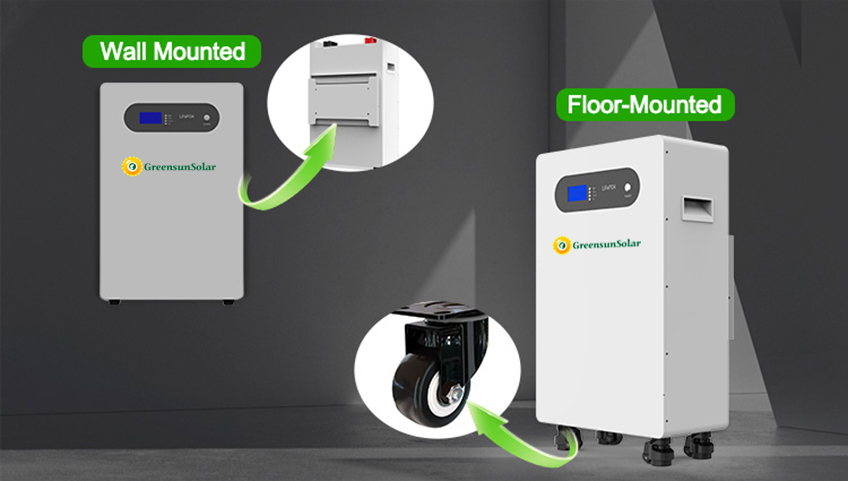
Plan for growth before you buy. Choose modular LiFePO4 batteries so you can enlarge the bank later without resizing the whole solar power storage. Confirm space, ventilation, and wiring updates in advance. Extra load from EV charging or new circuits usually drives expansion, so map expected demand early. This approach keeps your storage capacity matched to real use and protects your investment.
From Solar Battery Size to a Full System Example
A Worked Example
Put the whole sequence to work on one house. List each appliance's wattage and daily hours, then multiply. A cooker at 3,000 W for 3 hours draws 9,000 Wh. A refrigerator at 150 W for 24 hours adds 3,600 Wh. A computer at 50 W for 8 hours adds 400 Wh, and a TV at 100 W for 4 hours adds 400 Wh. The total is 13,400 Wh per day.
Now size the array. Divide 13,400 Wh by 5 average sunlight hours to get 2,680 W, then add a 20–25% buffer for clouds, shading, and non-optimal tilt. Battery sizing follows the same logic. Divide 1,850 Wh by 12 V to reach roughly 231 Ah, then adjust for depth of discharge. For a 10 kWh daily need, 10 kWh × 1.2 gives 12 kWh at 80% DoD, and a 40% cold adjustment lifts that to 16.8 kWh. Inverter size comes from peak load: 500 W × 1.2 = 625 W, with the surge rating matched to your largest appliance's startup draw.
For systems that combine battery storage and power conversion, GREENSUN provides a range of Hybrid Solar Inverters to consider when matching inverter capacity with your battery bank and solar array.
Quick-Reference Sizing Table
Use this table to find your ideal solar battery capacity fast. Read across from your daily kWh to the bank size at each depth of discharge.
| Daily Use (kWh) | Bank at 50% DoD | Bank at 80% DoD |
|---|---|---|
| 5 | 10 kWh | 6.3 kWh |
| 10 | 20 kWh | 12.5 kWh |
| 15 | 30 kWh | 18.8 kWh |
| 20 | 40 kWh | 25 kWh |
The table gives a starting point, not a final answer. A solar and battery calculator confirms the PV array, minimum and recommended panel counts, battery configuration, inverter, and charge controller current. Treat those outputs as preliminary and verify them against site conditions and manufacturer datasheets. For a confirmed design, GREENSUN's one-stop customized system service includes free consultation and design support, so you can lock in the right battery size for your solar system with battery before you buy. You can also explore GREENSUN's Battery Energy Storage Systems for integrated solar and battery configurations.
You now have the full sequence: daily energy use, depth of discharge, temperature derating, unit conversion, and days of autonomy. Run your own numbers through the quick-reference table to size a solar power system that fits your home. Then check peak load separately from daily kWh, since an undersized inverter can strand a full battery bank.
Take those figures to a qualified installer or a system design tool for final confirmation. A storage solar systems design built on measured loads will serve you well for years. Happy sizing, and enjoy the savings.
FAQ
How much battery capacity does a 10 kWh per day home need?
Divide daily use by usable depth of discharge. At 80% DoD, 10 kWh ÷ 0.8 gives a 12.5 kWh bank. Lead-acid at 50% DoD needs roughly double that rating. Add a cold-climate margin on top of either figure.
Should I size the bank to my whole bill or just critical loads?
Start with critical loads. They set the minimum your storage solar systems must cover during an outage. Whole-home consumption then decides whether you expand. Sizing to essentials first keeps cost down and still protects refrigeration, lighting, and medical equipment.
How many days of autonomy should I plan for?
One day suits a stable grid with short outages. Two days is the common target for off-grid living and multi-day weather events. Choose three or more for remote properties with harsh winters. Multiply your critical-load total by the number of days you pick.
Can I add batteries to my solar system with battery later?
Yes, if you plan ahead. Choose modular LiFePO4 packs and confirm space, ventilation, and wiring capacity now. Extra demand from EV charging or new circuits usually drives expansion. Higher bank voltage also shrinks amperage and wire size, which simplifies upgrades.
Do I still need a professional design check?
Yes. The table and formulas give a solid starting point, but site conditions and datasheets decide the final numbers. A qualified installer or design tool confirms panel count, inverter surge rating, and charge controller current. Many solar energy systems suppliers, including GREENSUN, offer free design consultation.